
 Have a code? Play
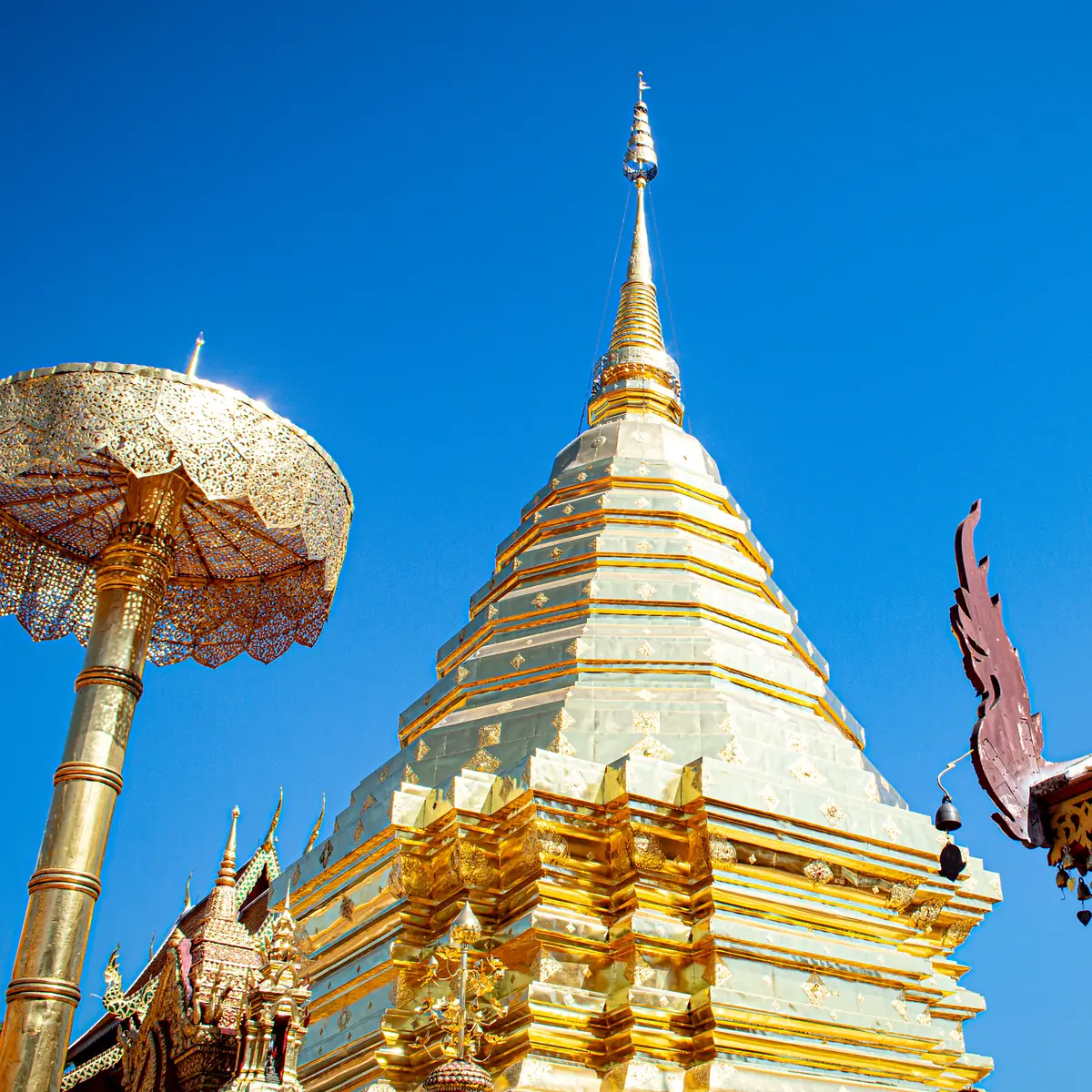
Doi Suthep, Philip Nalangan, CC BY 4.0
A walking puzzle · About 7.4 km · About 4 hours
Chiang Mai's a puzzle. Step into it.
Solve a riddle, walk to the spot, snap the photo. Every find adds a piece of the city; finish it and the picture is yours to keep and share. Free while we test.
A walking puzzle · About 7.4 km · About 4 hours
Solve a riddle, walk to the spot, snap the photo. Every find adds a piece of the city; finish it and the picture is yours to keep and share. Free while we test.
Have a code? Play now
The moat, Krzysztof Golik, CC BY‑SA 4.0
How it works
Riddle. Walk. Snap. Collect.
Read the riddle
Every stop starts as a tricky clue. Stuck? Each new clue is easier than the last.
Walk to it
Your phone tells you when you're in the right part of town. Pick your help: a search area of 150 m on Easy, 250 m on Medium or 300 m on Hard.
Snap it
Photograph the object from the street. Your phone checks the picture in seconds, and a match adds the piece to your picture.
Complete the city
25 pieces make the full picture. Finish it and the picture is yours to keep and share.
Try it now
This is the real first stop.
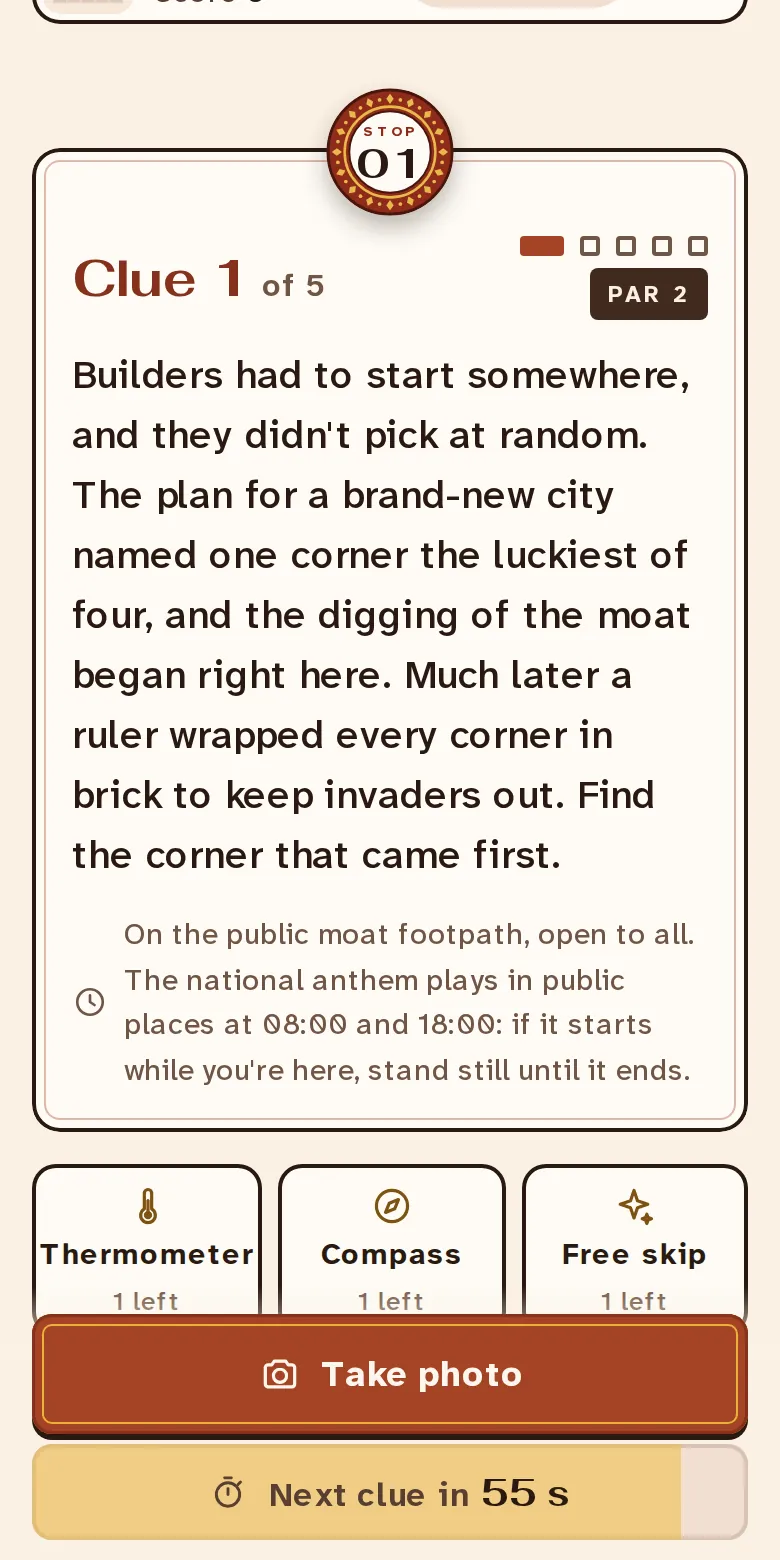
The same five clues every player gets at stop 1. Guess what it is, or ask for an easier clue and watch the difficulty drop. In the game, the clue you solve on is your score, and every stop has a par. This one is par 2.
The other 24 stops stay secret until you walk them.
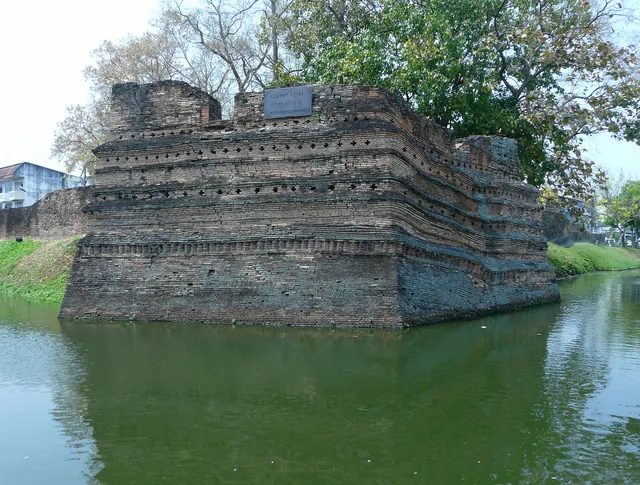
Si Phum corner, Hartmann Linge, CC BY‑SA 4.0
The answer
Si Phum Corner
The north-east corner bastion
Now showing
A morning with Jigwalk, in a minute.
Riddles inside the old city walls, a photo that adds a piece, the moat and the river, and Chiang Mai coming together one piece at a time. Tap to play with sound.

Chiang Mai and Doi Suthep, Blowing Puffer Fish, CC BY 2.0
The walk
One route. 24 secrets. No spoilers.
A fixed route of about 7.4 km on foot: from the corner of the old city where Chiang Mai began, through the temple lanes inside the moat, then out along the old trade road to the market quarter, the riverside lanes and over the Ping River to finish. You've already met stop 1. The other 24 stay in the fog until you solve your way into them.
- Distance
- About 7.4 km
- Time
- About 4 hours
- Pieces
- 25, one per stop
- Pace
- Yours. Stop for khao soi.
All on foot, start to finish, and nearly flat: no songthaew, tuk-tuk or taxi inside the game. Progress saves, and four breaks are built into the route: coffee at Akha Ama in the old city, water and ten minutes in the shade, a snack at Warorot Market, and a bowl of khao soi before the river.
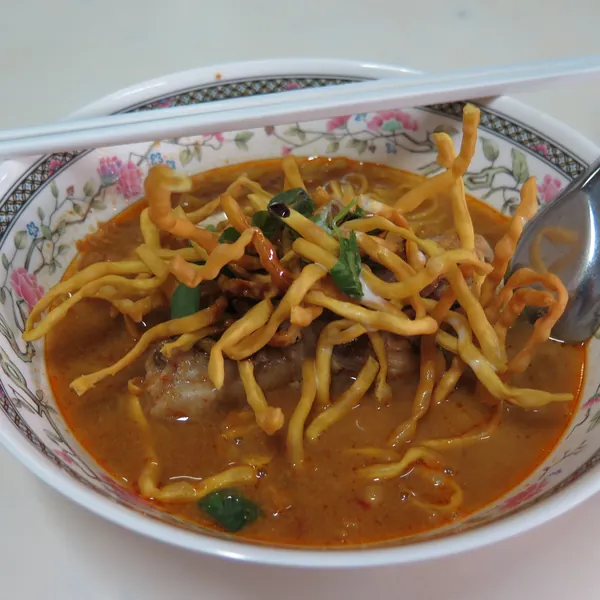
Khao soi, Douglas Perkins, CC BY 4.0
Three levels of help
Same clues. Your level of help.
Easy
An arrow leads you to the search area. Inside it, a thermometer runs cold, warm, hot as you close in. The search area is 150 m in radius. Lifeline: one Free skip.
- Arrow to the search area
- "Region unlocked" when you walk in
- Hot, warm, cold inside the circle, built in
Ways to play
Walk it. Share it. Race it.
Same 25 stops, same clues. Walk them at your own pace, as a crew, against the whole city on the leaderboard, or head to head against a friend.
-
Casual
Solo
Your pace, your level of help. Pick Easy, Medium or Hard, and change it from the menu whenever you like. Beat par, or just enjoy the walk.
-
Co-op
Crew
Link your codes across phones. One find counts for everyone, so you can split up and regroup. Every phone ends with the finished picture.
-
Leaderboard
Competitive
Hard rules: a 300 m search circle, no arrow, no thermometer built in. A 60 s wait between clues, and after a photo the checker is sure is wrong. Hard's three lifelines, strictly once each. Play it solo, or as a crew team that shares every find, every wait, the lifelines and the moves. Chosen at the start: switch to another mode later and there's no way back. Your moves and time go on the Chiang Mai leaderboards for the season, under a nickname or a team name.
- Thermometer
- Cold, warm, hot inside the circle
- Compass
- The arrow to your search area
- Free skip
- The next clue now, no wait, no extra move
-
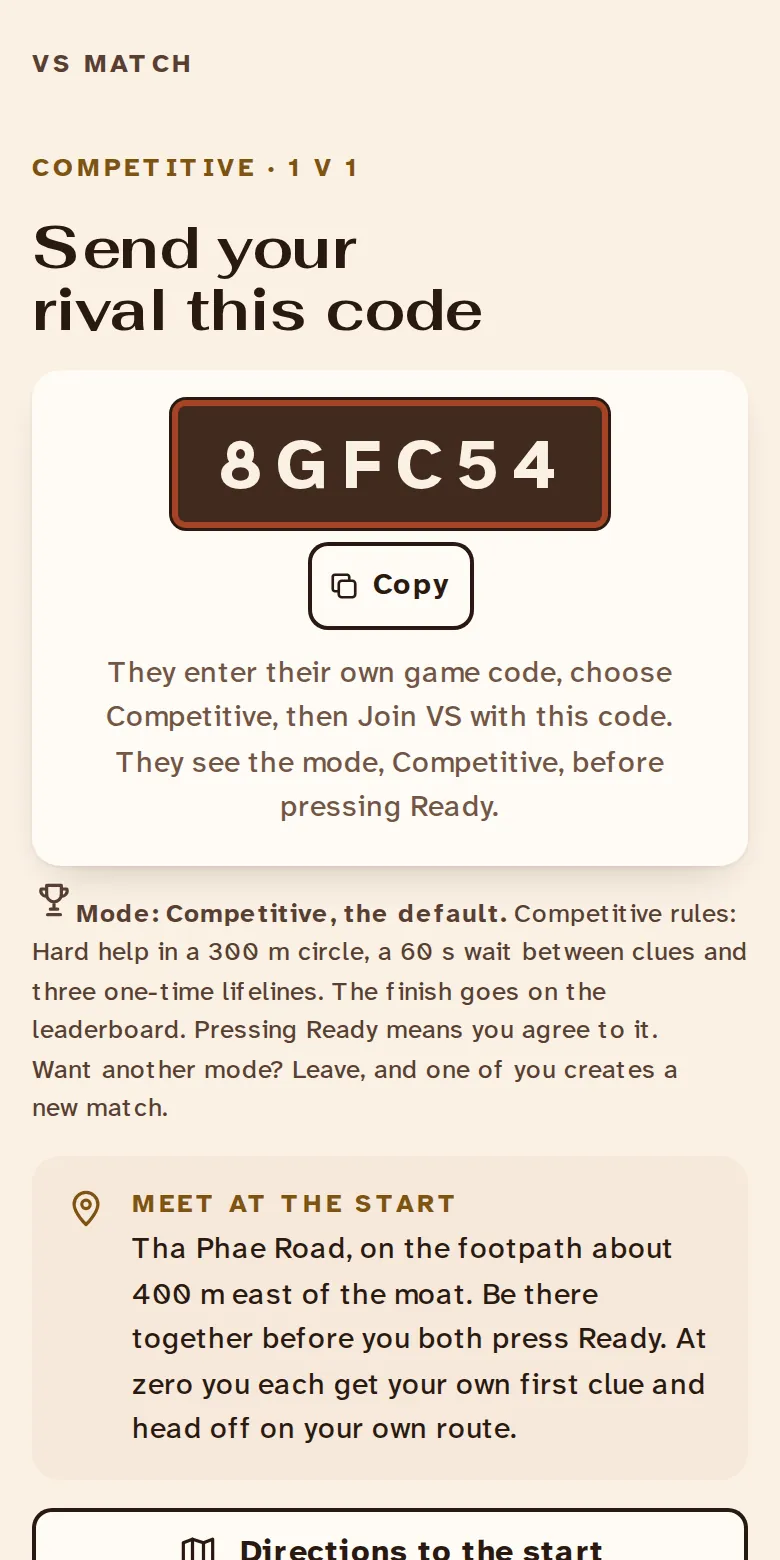
1 v 1
VS
Race a friend, even a crewmate, on Competitive rules, or on Easy, Medium or Hard if you both agree. Start a match and send them the 6-character code. They see the mode before they press Ready, so pressing Ready is agreeing to it. You meet at a shared start on Tha Phae Road, press Ready and count down together, then each walks the first stretches in a different order, so you never walk side by side, and you both race the same last stretch to the finish. All you see of your rival is their piece count. First to find all 25 wins. In a match your finds are your own, never shared with your crew.
Leaderboard billing Two boards. Best score: the fewest moves. Fastest: the quickest finish, timed from your first photo in the first search area.
Scoring
Golf rules. Beat par.
Each stop scores the number of the clue you solved it on. Get it on clue 1 and it costs one move; miss all five and walk in, six. Every stop has its own par. Par for the whole walk is 56, and a perfect game is 25. In Competitive, the same moves rank you on the Best score board.
- −Under par
- EPar
- +1One over
- +2Two over
- +3Three or more over
- WWalked in
- HUnlocked with help
At the finish you get a share card, Wordle style: your grid, your score, your mode and the distance you walked. No stop names, so it spoils nothing for your friends.
Chiang Mai · Medium
Groups and co-op
Better with your crew.
Link your phones into one team. When anyone photographs a find, the piece lands on every phone within seconds, so you can split up, race to a clue and regroup.
Every linked phone ends with the finished picture and its own keepsakes. Sharing one phone works too.
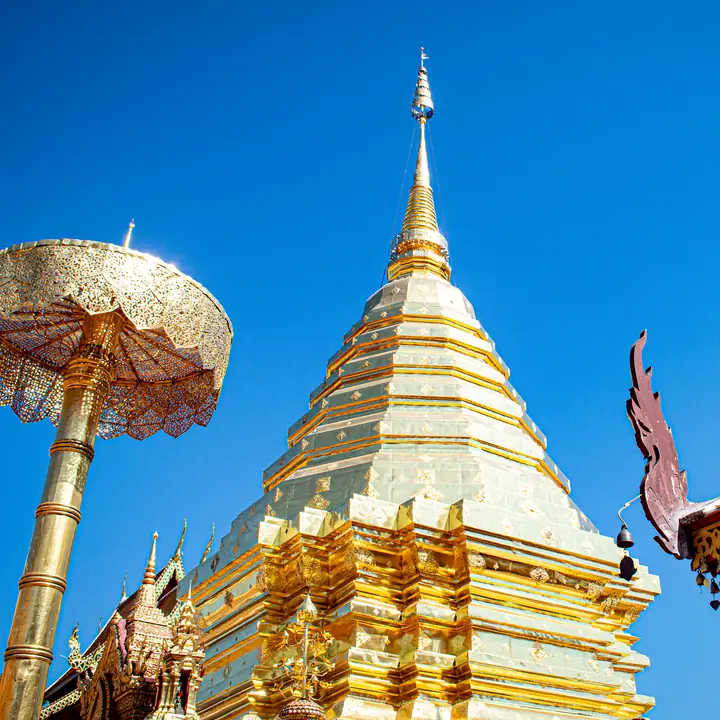
Doi Suthep, Philip Nalangan, CC BY 4.0
The finish
Finish the city. Keep the picture.
The finished picture. Every game deals your pieces to different spots on the board. Drag each one into place yourself, or let them fly home.
Keepsakes to share. A share card with your score, and a collage of your own 25 photos, saved to your phone.
Free while we test. The boxed jigsaw and a finish treat come with the official launch.
Plan your day
Start early. Eat well.
Chiang Mai is a morning city. Start at the corner at eight, while the air is cool and the temple grounds are quiet, and you're on the far bank of the river by about noon, before the heat. Add an hour for the four breaks and call it lunch.
Start at the corner
Stop 1, the north-east corner of the old city. From March to October, start at 07:30.
Coffee
Akha Ama, a short walk off the temple road, with beans from an Akha village in the hills to the north.
Water and shade
Find a shady bench in a temple ground for ten minutes. Water machines on the lanes fill a bottle for a few baht.
Warorot Market
The big market laid out in 1910: northern sausage, chilli dips and fruit from the ground-floor stalls.
Khao soi
Chiang Mai's curry noodles, crisp on top, at a family shop a few steps off the route.
Finish over the river
About 13:00 with every break. You never need a ride in between.
The year in one line
- November to February
- The best of it: cool, dry mornings and clear skies.
- March and April
- Burning season. Smoke from farm and forest fires can make the air unhealthy, so check the air quality the evening before and pick a clear day. Songkran, the water festival in mid-April, turns the moat into a friendly water fight: keep your phone in a waterproof pouch, or play another week.
- May to October
- Hot, then green and wet. Start at 07:30, carry water and a light rain layer, and take the breaks in the shade.
- Sundays
- Fine. The Sunday walking street only sets up in the afternoon, long after a morning game is over.
Pilot season
Free for testers. Right now.
Jigwalk is brand new and we're looking for its first players. Claim a free code, walk the city, and tell us how it went. Be one of the first to finish Chiang Mai.
Testers can claim codes for up to 4 players, linked as one team. One Chiang Mai claim per account, while tester places last. Prices, the boxed puzzle and the finish treat come with the official launch.
Every code includes
- All 25 stops and their riddle ladders
- Easy, Medium or Hard, your choice
- Competitive leaderboard and VS races
- Co-op sync across linked phones
- The finished picture, share card and photo collage
- Progress saved if your battery dies
- Valid until 7 days after you finish
Good questions.
How long does it take?
Plan for about 4 hours of play, or about 5 with the four breaks. Progress saves, so you can stop for longer whenever you like.
What do I need?
A phone with a camera, mobile data and location turned on, charged full before you start. It runs in the browser on any recent iPhone or Android, so there's nothing to install. Bring water, a hat, sunscreen and comfortable shoes, and wear something that covers your shoulders and knees for the temple stops. In the wet season, add a light rain layer.
What should we wear at the temples?
Shoulders and knees covered, for everyone. Every target is photographed from the street, a lane or the moat path, so you never need to go inside a building or a hall. If you do step into a temple ground, keep your voice low, take off your hat, and never sit or climb on a chedi, a wall or a statue. The game shows a short note before each temple stop.
How do the photos work?
Each answer is a building, a gate, a sign or a carving you can see from a public place. Stand where anyone can stand and photograph it; the game checks the picture in seconds. People are never the answer, so there's no need to photograph anyone, and nothing asks you to pose with anything.
How hard is the walk?
About 7.4 km at your own pace, almost all of it flat, on old city lanes, footpaths and the bridges over the moat and the river. Footpaths can be narrow or broken in places, so look down as well as up.
How hot does it get?
Hot by late morning for most of the year, which is why the game starts at eight (07:30 from March to October) and is done by about noon. Drink often, take the breaks in the shade, and slow down when you need to. November to February is the coolest and kindest time to play.
Is the tap water OK?
Drink bottled water. Water machines on the lanes refill a bottle for about a baht a litre, and there's a 7-Eleven on almost every block. Temple grounds and the market have toilets; cafés are there for customers.
How do we cross the moat roads?
The roads either side of the moat are one-way, several lanes wide and busy with scooters. Cross at the lights wherever you can, check both ways even on a one-way road, and walk the footbridges over the water. Look up from your phone at every kerb.
Where does it start?
At Si Phum, the north-east corner of the old city moat, where the roads round the moat meet. A red songthaew or a taxi app will drop you at the corner. A VS race starts somewhere else: you meet at a shared start on Tha Phae Road before the countdown.
How do we get home?
The game finishes on the east bank of the Ping River, about 1.5 km from the old city. Walk back over the river, or flag a red songthaew or book a ride: both are easy to find on the riverside roads.
Do we need a songthaew or a tuk-tuk?
No. The whole game is on foot, with no ride in the middle, so the clock never has to pause. A ride can get you to the start and home again.
What about the national anthem at 08:00?
In some public places the anthem plays at eight in the morning and six in the evening, and people stop and stand still. If you hear it at the start, do the same for the minute it plays, then off you go.
Is Sunday a good day?
Yes. The Sunday walking street fills the temple road from mid-afternoon, and a morning game is long over by then.
What about the burning season and Songkran?
In March and April, smoke from farm and forest fires can make the air unhealthy: check the air quality the evening before and pick a clear day, or come another month. In mid-April, Songkran turns the moat into a water fight; it's great fun, and hard on phones, so play another week or bring a waterproof pouch. An unused code stays open for a year.
I live here. Is it still for me?
Yes. The riddles work for first-timers, and they're written to surprise people who have lived here for years: most of the 25 are things you can walk straight past.
Can we bring kids?
Yes, if they're happy with the distance and the heat. Hold little hands near traffic and the moat's edge, take breaks whenever you need them, and keep everyone in the shade at the stops.
Where can we eat?
Four breaks are built in: coffee at Akha Ama in the old city, water and shade at a temple ground, Warorot Market for northern snacks and fruit, and a bowl of khao soi on a lane near the river. Hours can change, so check them on the day. Progress saves, so stop whenever you like.
Is it safe?
Every stop is in a public place you can reach on foot, and you photograph from where anyone can stand. Cross at the lights, keep an eye out for scooters on the lanes and footpaths, watch your step on broken paving and beside the water, and look up from your phone at the kerb.
What if it rains?
Every find can be photographed from a public place, so a shower need not stop you: bring a light rain layer, and a café is never far away. Wet-season rain often comes later in the day, another reason to start early. If the day looks wild, an unused code stays open for a year.
What if I get stuck?
You never get stuck. Ask for the next clue whenever you like. If all five clues miss, the game shows you where the thing is, and walking within 25 m of it adds the piece. You just score a six for that stop.
What if GPS or my camera fails?
The game lets you move on. A patchy location fix or a photo the checker can't read never ends your day: carry on to the next stop, and that piece shows as unlocked with help on your card.
Can we play as a group?
Yes. Share one phone on one code, or link several phones so a find on one unlocks for everyone. Linked codes can also play Competitive as one team, with one name on the leaderboard, and race each other in VS.
Do Competitive and VS cost extra?
No. Every code can play Solo, Crew, Competitive or VS, and testers pay nothing at all. Linked codes can play both: Competitive as one team, and VS against anyone, crewmates included.
How do lifelines work?
Each mode comes with its own, each once per walk. Easy has its arrow, circle and thermometer built in, plus a Free skip. Medium has its arrow, plus a Free skip and a Thermometer. Hard has nothing built in, plus a Thermometer, a Compass and a Free skip. The Thermometer runs cold, warm, hot inside the search area and the Compass points to it, both until you solve that stop; the Free skip shows the next clue at once, with no wait and no extra move. Every 5 stops a quick question asks what you saw, and every right answer wins another lifeline. Competitive has Hard's three, strictly, and a crew playing as a team shares one set. A VS match plays the lifelines of the mode you both agreed on.
Can I play VS with a stranger?
Yes, as long as they have their own Jigwalk code. There's no matchmaking: send the 6-character match code however you like, they choose Competitive and Join VS, and see the match's mode: Competitive unless you picked Easy, Medium or Hard when you made it. Pressing Ready means you both agree to it. A match that never starts closes after 12 hours.
What do the leaderboards show?
Finished Competitive walks in Chiang Mai, VS matches on Competitive rules included, on two boards. A VS match on Easy, Medium or Hard is a friendly race, so it doesn't go on the leaderboard. Best score ranks the fewest moves first, with the faster time breaking a tie. Fastest ranks the quickest finish first, with fewer moves breaking a tie. Each line shows a nickname or a team name, then moves, time and lifelines used.
Do I need an account?
Not to play: your game code is all you type in. Free tester codes are claimed with an account, one claim per account for each city. The leaderboard only ever shows the nickname you choose at the finish.
What language is it in?
English.
How long is my code valid?
Until 7 days after you finish. If you haven't finished, it stays open for a year from when you get it.
Does it cost anything?
Nothing, for now. Chiang Mai is free while we test it. Prices, the boxed puzzle and the finish treat come with the official launch.

Wat Suan Dok, Yakuzakorat, CC BY‑SA 4.0